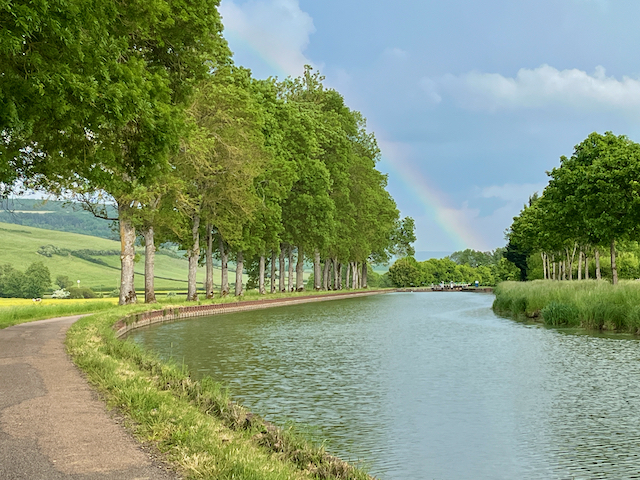
We loved our first Saroche experience so much that we returned – this time to explore Burgundy.
And once again, we enjoyed a perfectly choreographed blend of sightseeing, wine tasting, relaxing on board, and of course, delicious meals!

One notable difference on the canal in Burgundy vs Champagne is that the locks are manually operated rather than automatic. On our first day, we traversed seven locks so we spent quite a bit of time with the two-man team that operated them. Once the barge went through each lock, they sped ahead along the towpath on their scooters to wait for us at the next one – a full afternoon’s work!
I tried my hand at opening one of the gates (the locks used to be run by women, since the men were working in the fields); it was heavy but once I got some momentum, not too bad.
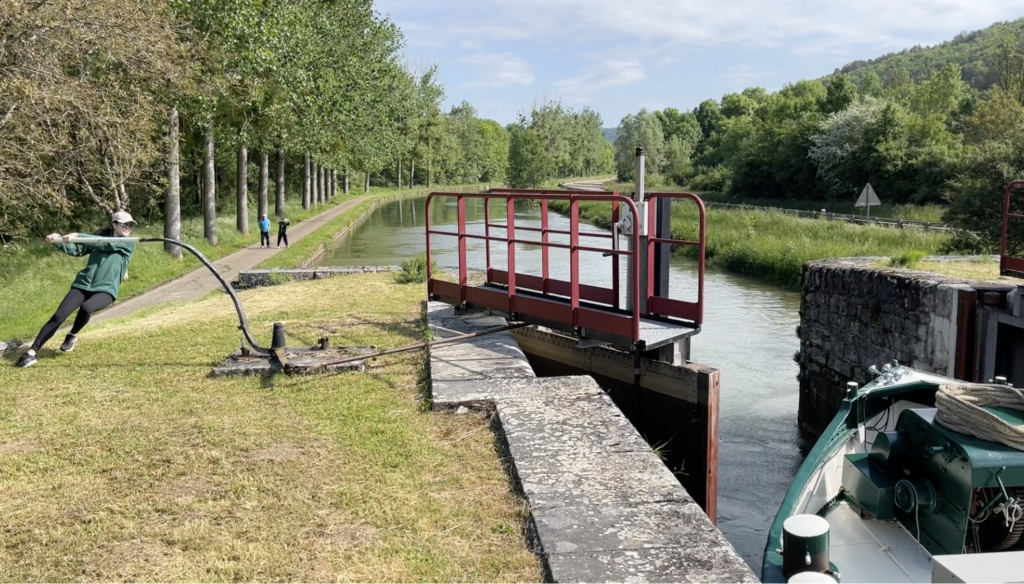
This timelapse from later in the trip shows the process:
We sometimes walked or biked along the tow path while Saroche was underway, measuring the distance by the number of lock houses we passed. Many are unoccupied (some aren’t accessible by road), but others are charmingly colorful, with gardens and flowers and dogs, including a very excitable dachshund named Susan.
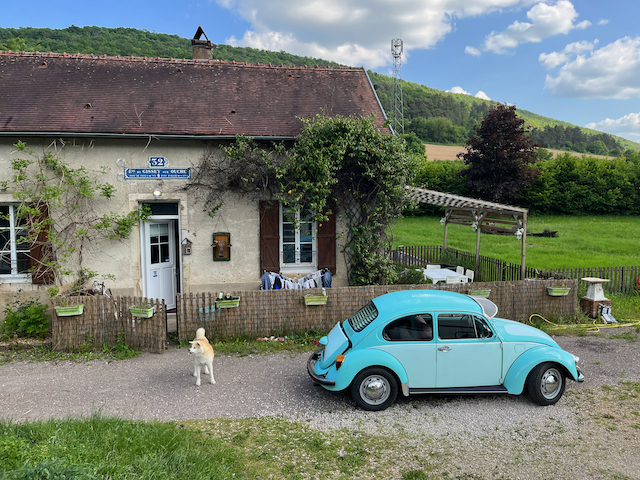
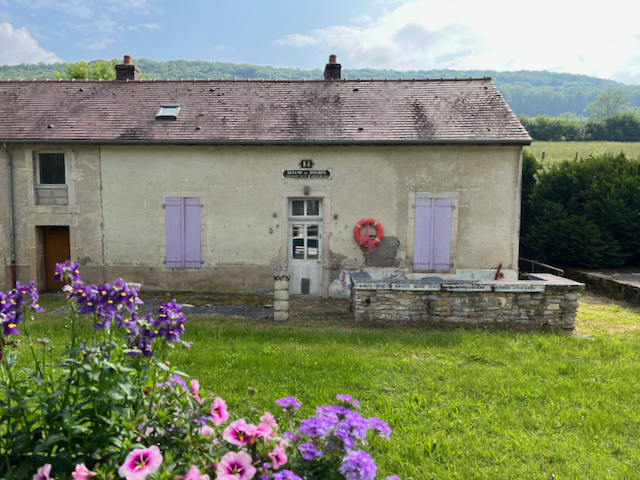
A few highlights:
Chateau de Commarin
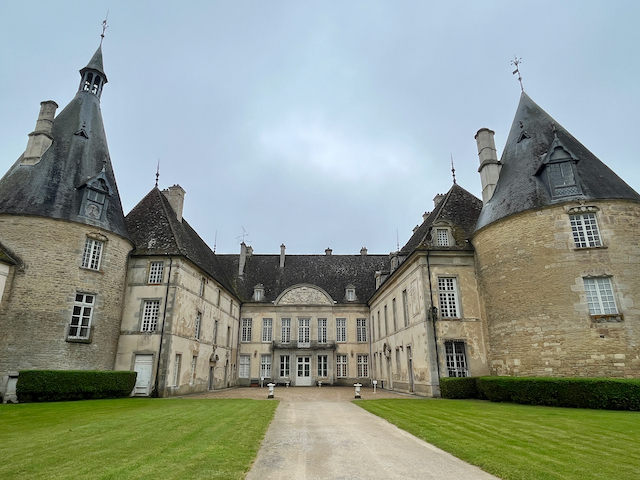
Chateau de Commarin is still owned by the original family, since the Comte de Vienne of the late 1700s survived the French Revolution owing to his essential military knowledge. Today it’s a nice spot to visit, complete with a large pig who roams the grounds (a natural lawn mower), a friendly chocolate Lab, and a small coffee shop.
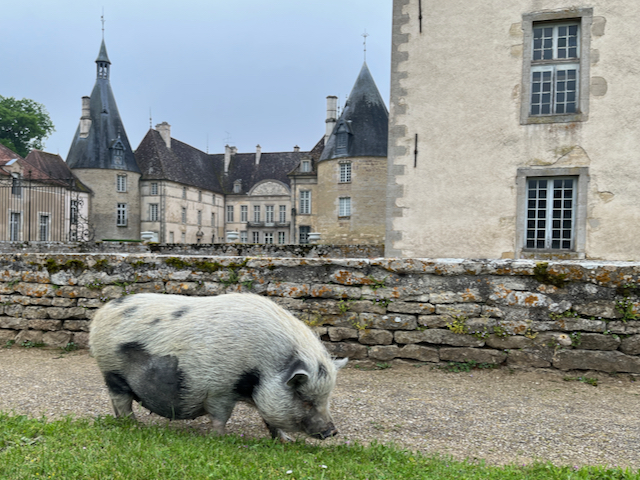
Chateauneuf-en-Auxois
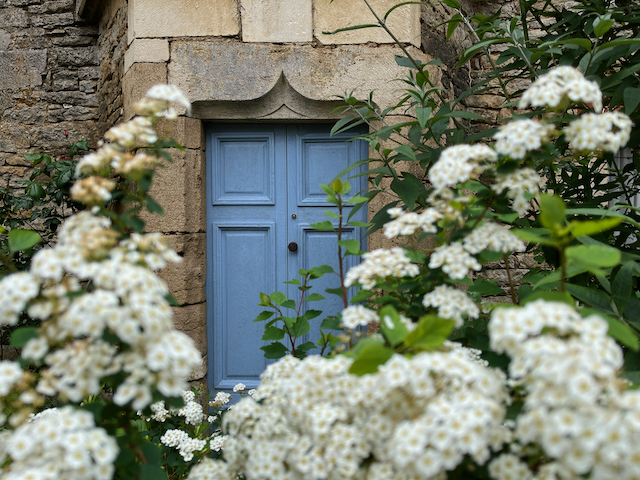
A particularly pretty stop was Chateauneuf-en-Auxois, one of the “most beautiful villages” of France (yes, this is an official designation)
It has a sweeping overlook of the landscape, including the canal and pastures dotted with white Charolais cattle. The village itself is filled with lovely old stone buildings, including one completely covered by a vine that has been growing for over 600 years.
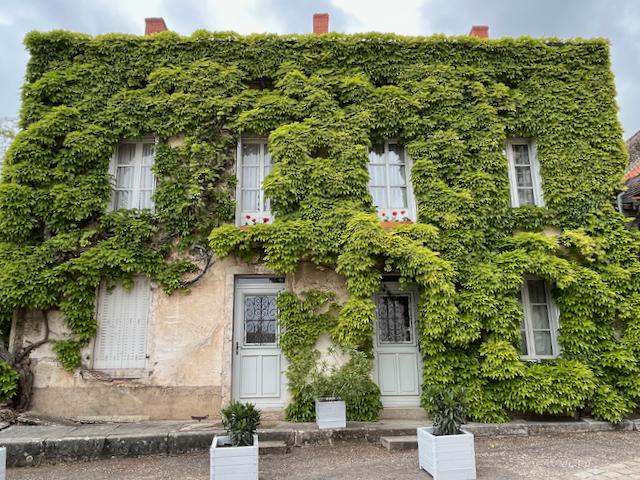
We walked through the Chateau de Chateauneuf, a well preserved medieval castle that hulks at the top of the hill and serves as a local landmark (it’s visible from the autoroute).
Hospices de Beaune
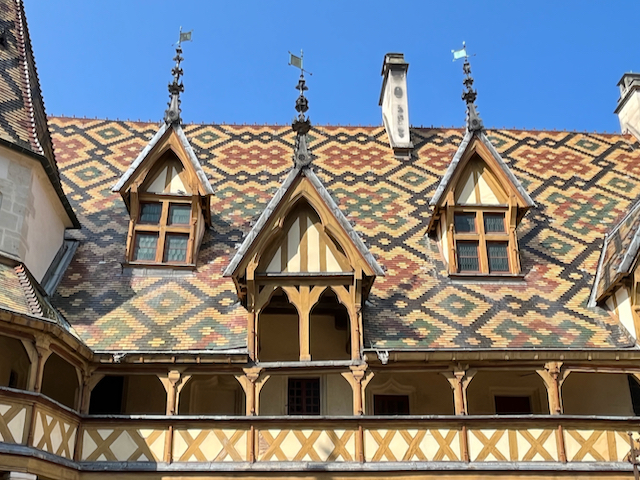
We spent a morning exploring the Hospices de Beaune, founded in the 1400s as a hospice that welcomed the sick and dying poor to treat them (if possible) and more importantly to prepare them for heaven. There were also spaces for the middle and upper classes to be treated, which were less crowded and had fancier decor and private chapels. The beds were the same size regardless (aka very small), though the poor were more likely to be piled in 4 or 6 per bed. Since malnutrition was common, some of the “dying” made good recoveries just from having access to good, healthy food. Those lucky ones were allowed to stay and work in the hospice. Over the centuries, the hospice became more of a hospital, focused on treatment and recovery rather than serving as the gateway to heaven.
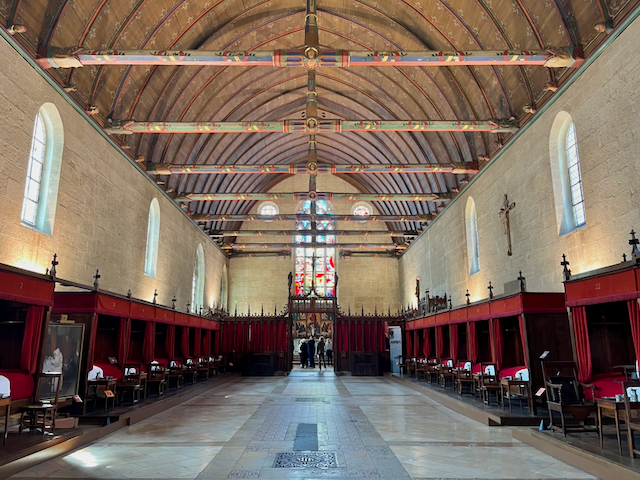
It also collected quite a lot of donations over the years – money, art, and most notably, swaths of Burgundy vineyards. Each year there is a charity auction of Hospice de Beaune wines and the proceeds support the modern hospital, one of the best equipped hospitals in France.
The current Hospices winemaker is a woman, and while there were apparently grumblings about this, she is quite talented and wine auction proceeds have increased each year under her guidance.
Hospices wines are named for their vineyards, and two of the biggest are Guigone de Salins and Nicolas Rolin – the founders of the Hospices in the 1400s. Nicolas was the Duke of Burgundy’s financial chancellor and Guigone came from a wealthy family of builders; it was the second marriage for both. They were quite pious and donated vineyards that still produce wine to support the same hospice over 600 years later.
Les vins de Bourgogne
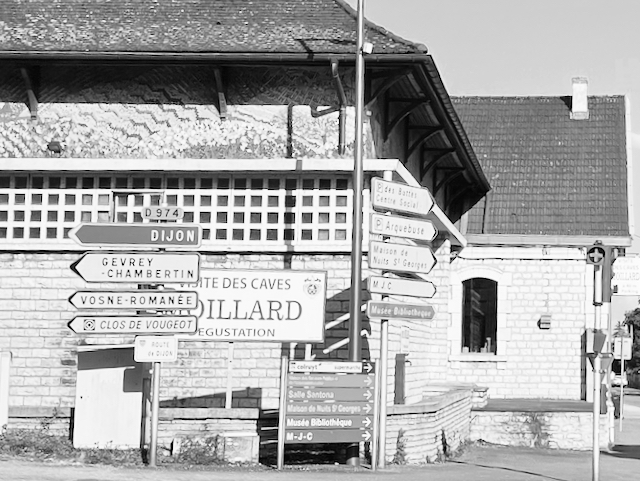
Of course no visit to Burgundy would be complete without some wine tasting. One of the highlights was Patriarche, which has extremely extensive underground cellars – it took a solid 5 minutes to walk from the tasting room to the exit, all through winding underground corridors. In fact, in Beaune you can cross the city entirely underground, going from cellar to cellar (assuming you have all the keys), which the French resistance made good use of during WWII.
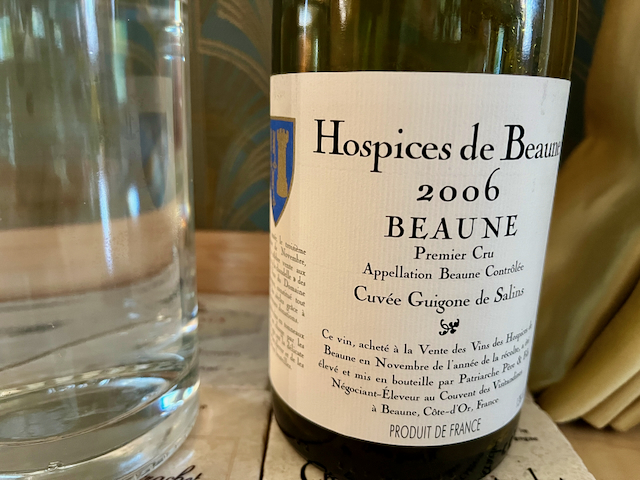
We had an enjoyable tasting – the highlights were the 2019 Les Folatieres 1er Cru Puligny-Montrachet and 2018 Hospices de Beaune Cuvee Guigone de Salins 1er Cru. As Olivier, our sommelier and guide explained, the Guigone wines are meant to be elegant and complex, while Nicolas de Rolin wines are stronger and more tannic.
We also visited Clos de Vougeot, now run by the Confrérie des Chevaliers du Tastevin (basically a lively wine-focused society that has dinners and tastings). Here we had a chance to learn more about the nuances of Burgundy wine – where a single vineyard may have dozens of owners, some who make wine from just one or two rows of vines. About 55 million bottles of wine are produced in all of Burgundy, compared to 55 million bottles of champage just from one maker, Moet & Chandon, or 180 million bottles in all of Bordeaux. The average Burgundy winemaker produces around 1350 bottles of wine annually.
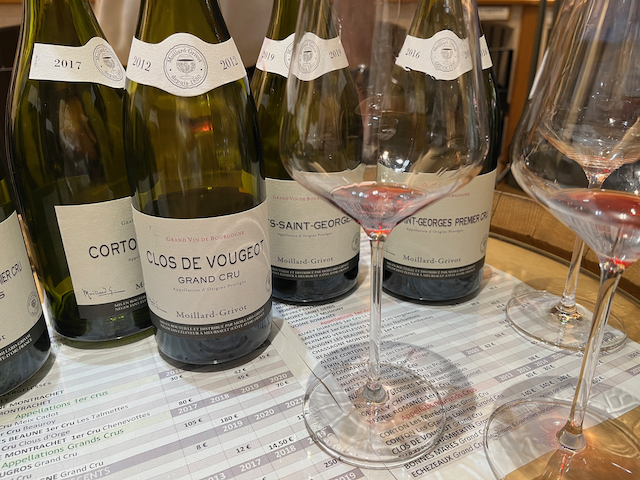
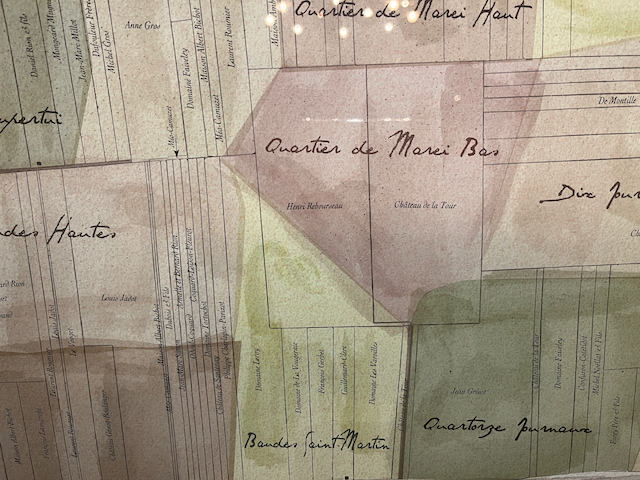
The vineyard map below gives a sense of how small some of the winemaker’s plots are.
Dijon
We visited Dijon for the Friday market, which is held in and around a large, ornate glass-and-iron food hall designed by Gustave Eiffel of Eiffel Tower fame. Lots of fresh produce, cheese, seafood, meat, and escargot of course. I bought one of those classic straw market baskets (which now hauls Chicago farmer’s market produce) and some quiche and pate in brioche that served as travel snacks as D and I embarked on the next leg of our trip to Switzerland. And of course I bought some Dijon mustard from Edmond Fallot.
Aboard Saroche
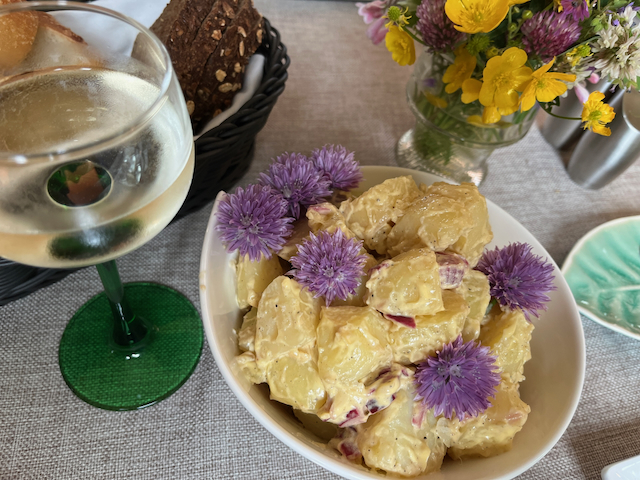
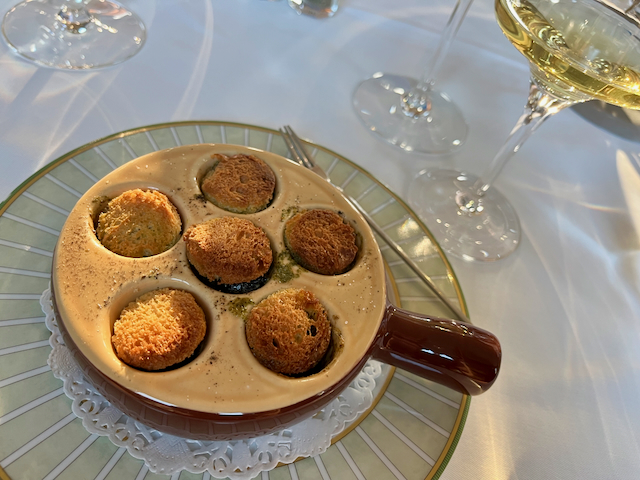
The greatest luxury of a trip on Saroche is the quiet, relaxed rhythm of each day: Breakfast, an outing, lunch, then a few hours of relaxation and doing exactly what you’d like. Settle down with a book, walk a little, or just laze on the deck and watch the scenery drift by. Wrap up with one of Dawn’s amazing dinners and wine selected by Jason, then it’s off to bed to be lulled asleep by the faintest motion of the canal.
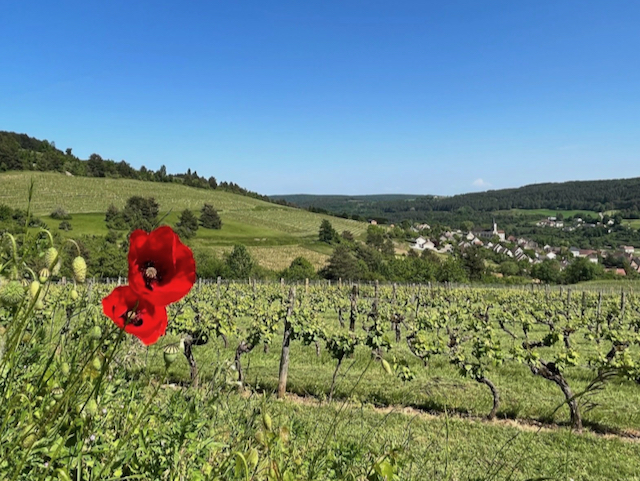
Merci! Et à la prochaine!
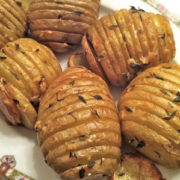 Hasselback potatoes for NYE. Happy 2012!
 Yakitori under the tracks at Yurokucho, Tokyo
 Gen Yamamoto cocktails, Tokyo
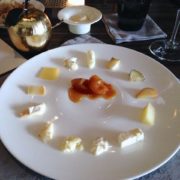 Cheese x 13 at Brindille, Chicago